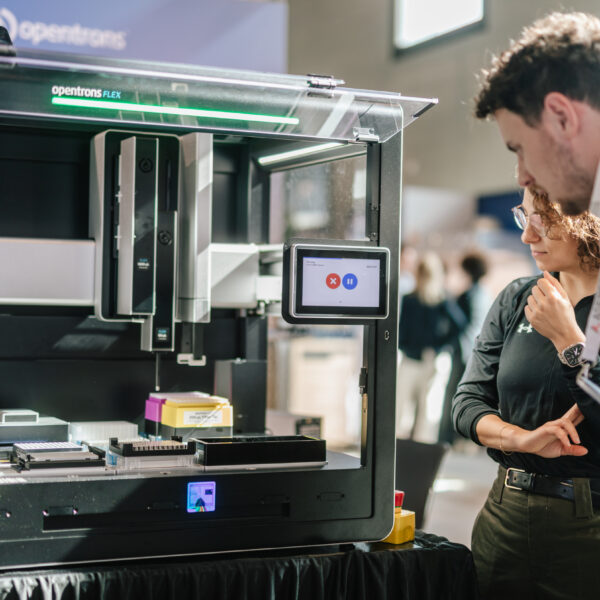
Convenient organization, analysis, and protection of data

Everything Connected? – Then Software with Multiple Benefits Can Be Installed
Devices in laboratories and production are becoming increasingly communicative. This is driven by the growing standardization of data formats, which in turn creates opportunities for simplification and improved security—as highlighted by the pioneering industry event in chemistry and life sciences, Ilmac 2025 Basel.
In the first step, data from a wide variety of devices is converted using specialized software, ensuring smoother communication flows both between devices and with higher-level systems. On the laboratory level, this particularly affects the LIMS (Laboratory Information Management System), on the audit-preparation level the ELN (Electronic Lab Notebook), and on the operational level the ERP (Enterprise Resource Planning). The relatively new laboratory device standard LADS has further accelerated the efficient networking of devices, automated systems, and processes.

Within LIMS, it is now possible to store files in a SQL database (Structured Query Language). Here’s an example: A laboratory technician records a near-infrared spectrum (NIR) to identify and quantify polyethylene terephthalate in a mixture. Alongside the spectrum, she stores her name, the time of the analysis, the method used (e.g., an internal designation such as “Polymer in Food”), the sample (e.g., Sample No. 25), and the analysis device. For complete documentation, the most recent calibration date of the device is also recorded, possibly with two signatures (e.g., the calibrating technician plus the approving lab manager).
Storage in a relational database automatically links this data to other records. Later, queries can go beyond the individual analysis result, for example to determine which analyses were carried out on a given day or over the past two weeks, which NIR spectra were recorded on a specific device in the past two months, or which results fell outside of an FDA-defined compliance range. Taking it a step further, cloud-based storage allows company-wide access to the data from all locations.


Picture 2 and 3: The alternative to still widely used handwritten records is the Electronic Lab Notebook (ELN)—here illustrated with the final signature of an electronic document on a virtual notebook screen. (Images: Depositphotos)
How economy and data security can be harmonized—and how the many opportunities of current LIMS software can be enjoyed without concern—will be showcased at Ilmac Basel 2025. All details about the event, participating companies, and program highlights can be found on Ilmac 365, the community network of Ilmac: https://365.ilmac.ch/event/ilmac-basel-2025